
The Real Face of Patrick Henry
1788 Terracotta Bust Reconstruction
An accurate likeness of Patrick Henry?
This life bust of Patrick Henry was sculpted from life in 1788 by an Italian artist traveling through Virginia. Although the original work included the upper torso, everything below the neck had already been lost long before the Patrick Henry Memorial Foundation acquired the sculpture. Unlike painted portraits, this bust was modeled directly from Patrick Henry during a sitting in 1788, making it one of the most important surviving references for his actual appearance.
Historical accounts indicate that Henry sat for the sculptor during the Virginia Convention that ratified the United States Constitution. In an 1859 account, T. W. Walter of Washington, D.C., wrote that the sitting was arranged at the request of several prominent Virginians, including Judge John Tyler Sr., James Madison, and John Marshall. Walter also recorded that those who knew Henry regarded the bust as an exceptionally accurate likeness and that it remained in the possession of his family for many years.
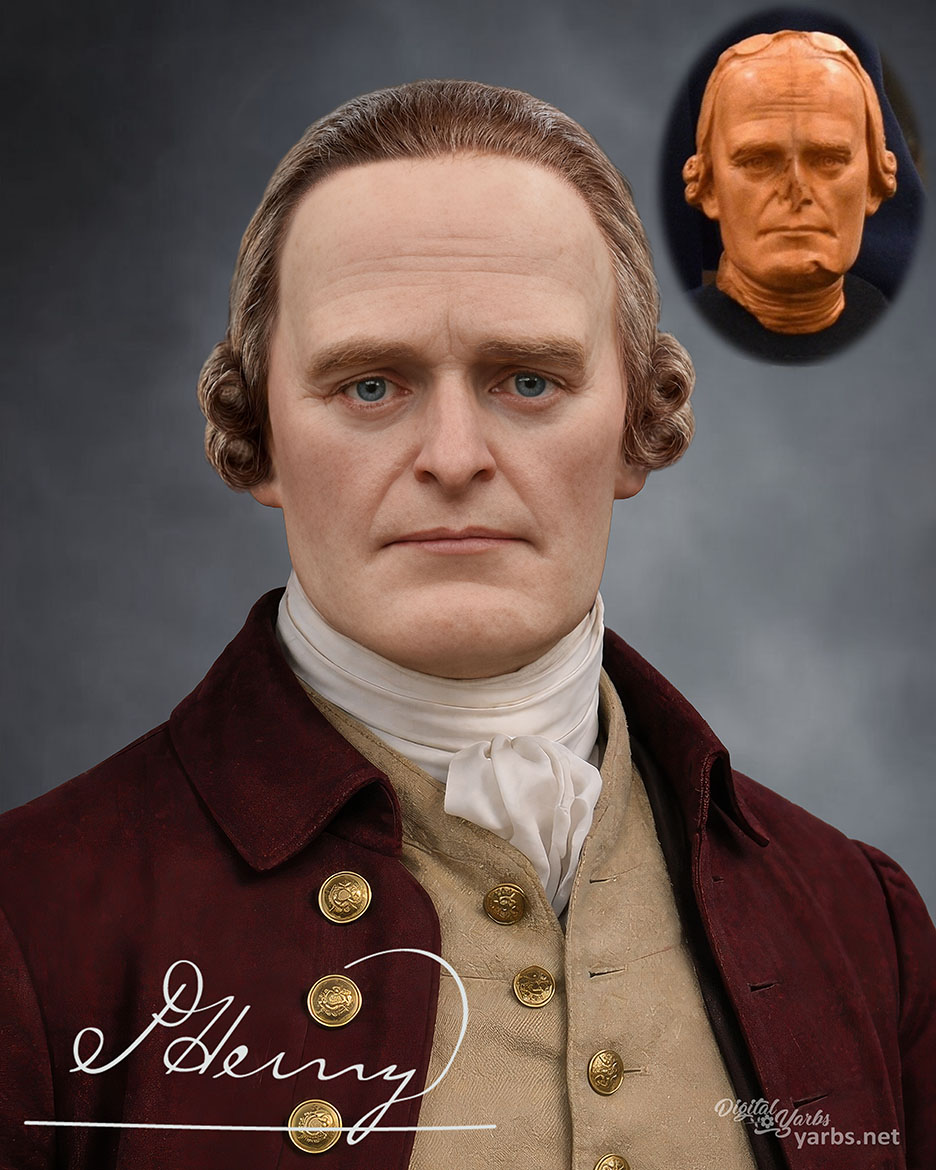
Following Patrick Henry's death, ownership of the bust passed to his sister, Elizabeth Henry Campbell Russell. It remained in the family's care through successive generations until it was acquired by the Patrick Henry Memorial Foundation in 1996.Today, the bust survives in a worn condition, missing portions of the nose and chin.
Henry himself was described as having blue or hazel eyes and reddish-brown hair. In 1770, he purchased a brown bob wig from Edward Charleton’s peruke shop in Williamsburg and shaved his head to ensure a proper fit. He continued wearing the wig for the rest of his life, even after such fashions had faded. A lawyer, orator, and statesman, Henry played a central role in the founding era of the United States. He served in the House of Burgesses (1765–1774), as the first governor of Virginia (1776–1779), in the House of Delegates (1779–1784; 1788–1791), and again as governor (1784–1786). He was also a founding member of the Virginia Committee of Correspondence (1773) and a delegate to both the First and Second Continental Congresses.
He is best remembered for his speech at the Virginia Convention of 1775, which concluded with the immortal words, “Give me liberty, or give me death!” His contemporaries regarded him as “the man who gave the first impulse to the ball of revolution.”
Henry retired from public life in 1791, declining offers to serve on the Supreme Court, as secretary of state, and even as a vice presidential candidate. Only a personal appeal from George Washington amid the political tensions surrounding the Alien and Sedition Acts drew him back. Though elected again to the General Assembly in 1799, he died before taking his seat.
Digital Yarbs Complete Works
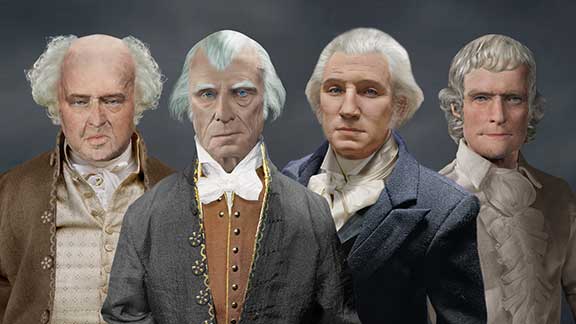
Life Mask Facial Reconstructions of History
Witness the authentic faces of historical figures reconstructed with the remarkable capabilities of Photoshop, utilizing actual plaster life mask castings of their heads and upper torsos.

Colorizations and Enhancements
Utilizing the powerful tools of Adobe Photoshop and AI, I breathe new life into vintage photographs and daguerreotypes by colorizing, enhancing, de-aging, and occasionally reconstructing them.

Free Image Downloads
Tired of AI-generated historical figures that don’t actually resemble the real people? Free historically accurate images for you to use!
Latest Digital Yarbs Video
Click that red subscribe button to stay up to date with my latest content.